Weatherwise Finishing Layers
If using your balcony requires carrying four bulky cushions out of a bedroom closet before you sit down—and rushing them back inside at the first sign of rain—the space quickly becomes a chore. A genuinely livable balcony relies on materials engineered or naturally suited to stay outside from April through November with minimal intervention.
The goal is not indestructible plastic, which feels cold and clammy against bare skin in summer, but rather tactile materials—thermally modified hardwoods, solution-dyed acrylic bouclé weaves, frostproof stoneware, and matte powder-coated aluminum—that shed water rapidly and soften in tone as the seasons pass.
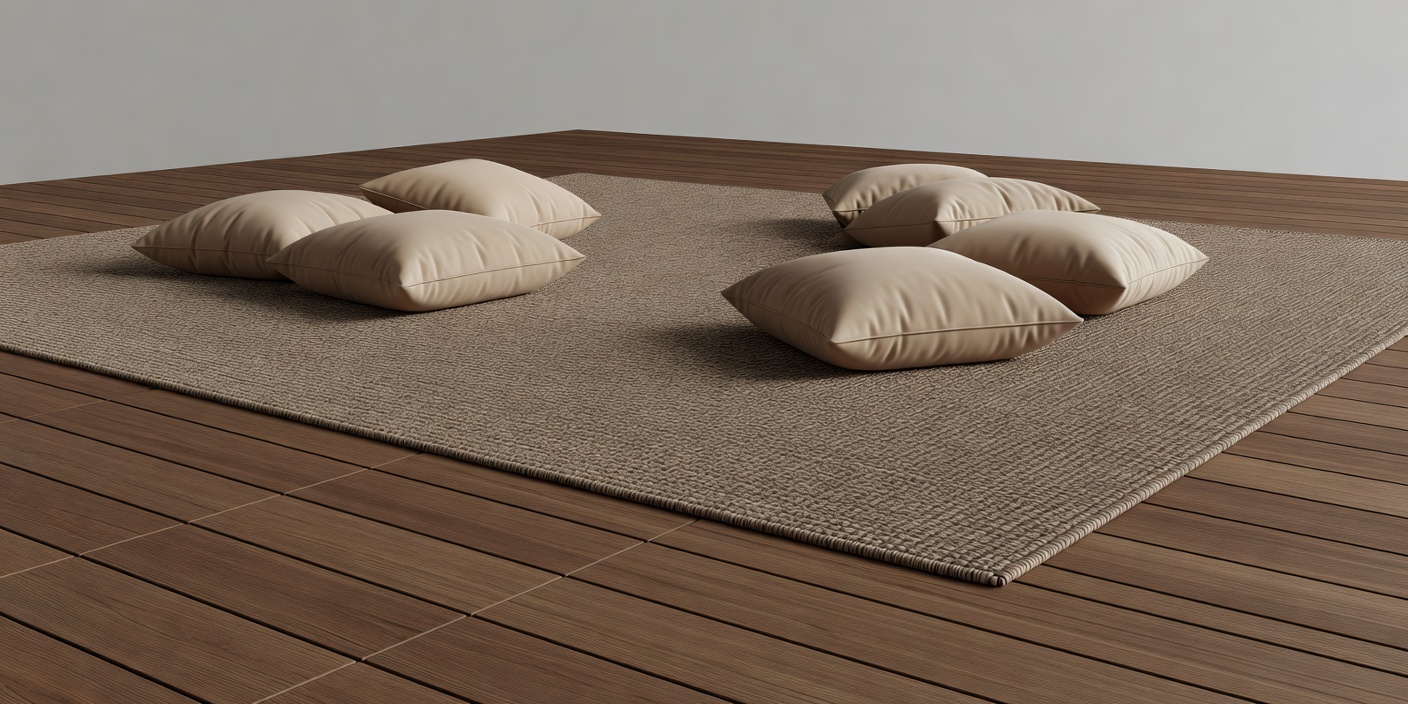
1. Underfoot: Stepping Out in Bare Feet
Raw broom-finished concrete slabs absorb heat on sunny afternoons and stay gritty with urban dust. Adding a dry, warm floor layer transforms the balcony into an extension of your indoor hallway so you can step out in socks or bare feet with your morning coffee.
Thermally Modified Ash or FSC Acacia Click-Tiles
Kiln-baked in a steam-controlled chamber at 212°C without harsh chemicals, thermally modified ash resists rot and cupping. Choose tiles with stainless-steel underside screws (not staples that rust) mounted on 12 mm drainage grids.
Open-Weave Recycled PET & Polypropylene Flatweaves
Avoid thick tufted outdoor rugs with latex backings, which act like wet sponges against concrete. Instead, choose a reversible flatweave loomed from extruded PET yarn that lets rainwater pass straight through to the drain beneath.
Porcelain Pavers on Low-Profile Rubber Pedestals
Where building fire regulations prohibit timber decking (such as UK Approved Document B rules on high-rise residential buildings over 18 meters), 20 mm vitrified sandstone-look porcelain tiles on 10 mm acoustic rubber pads offer Class A1 non-combustible warmth.
“The best outdoor textile is the one that dries faster than you finish your breakfast. Look inside the zipper: if the foam core is closed-cell indoor polyurethane, leave it in the showroom.” — Material Specification Notes
2. What Makes a Cushion Truly Weatherproof?
Many cushions sold as “outdoor” merely wrap a water-repellent polyester cover around standard indoor sponge foam. Once water inevitably enters through the stitched seams, the core stays damp for days and smells musty. True all-weather upholstery pairs a solution-dyed acrylic outer weave (where UV-stable pigment is mixed into the liquid polymer before the yarn is spun, like a carrot rather than a radish) with a reticulated open-pore foam core and a perforated mesh bottom panel.
3. Exposure & Care Matrix by Microclimate
Match your finishing palette to the specific forces hitting your facade.
| Balcony Exposure | Primary Stress Factor | Recommended Finish Palette | Material to Avoid |
|---|---|---|---|
| High-Altitude South / West | Intense UV & radiant heat | Sand powder-coated aluminum, weathered teak, solution-dyed oatmeal linen-weave acrylic | Dark charcoal steel (burns skin at 55°C+) and piece-dyed cotton canvas |
| Coastal or Salt-Air Zone | Salt-mist corrosion | Marine-grade 316 stainless hardware, anodized bronze, teak, glazed stoneware | Standard electro-plated steel screws and untreated wrought iron |
| Freeze-Thaw Winter Climate | Ice expansion in pores | Fiberstone, high-fired frostproof stoneware, elevated pot feet | Low-fired terracotta left sitting directly in pooled meltwater |
| Shaded North / Courtyard | Slow evaporation & algae | Slatted metal frames, quick-dry sling mesh, breathable porcelain | Dense sisal or jute rugs that hold dampness in shade |