Light for Longer Evenings
For nine months of the year, an unlit balcony vanishes behind a black mirror the moment the sun drops below the horizon. When your indoor living room lamps are switched on and the balcony outside is dark, the double-glazed glass door reflects the interior right back at you, making your apartment feel boxed in. Yet flipping on a builder-grade 4000K wall sconce floods the slab with hospital-white glare.
Good outdoor lighting does two quiet things at once: from the sofa inside, it illuminates the far boundary of the balcony so your eye travels through the glass into a warm exterior room; when you step outside, it pools gentle amber light around your book and teacup while leaving the night sky dark above you.
1. The Three-Point Low Horizon Rule
Instead of stringing bright bulbs overhead along the ceiling soffit—where every neighbor for three blocks can see bare filaments—anchor your lighting in three subtle tiers below waist height.
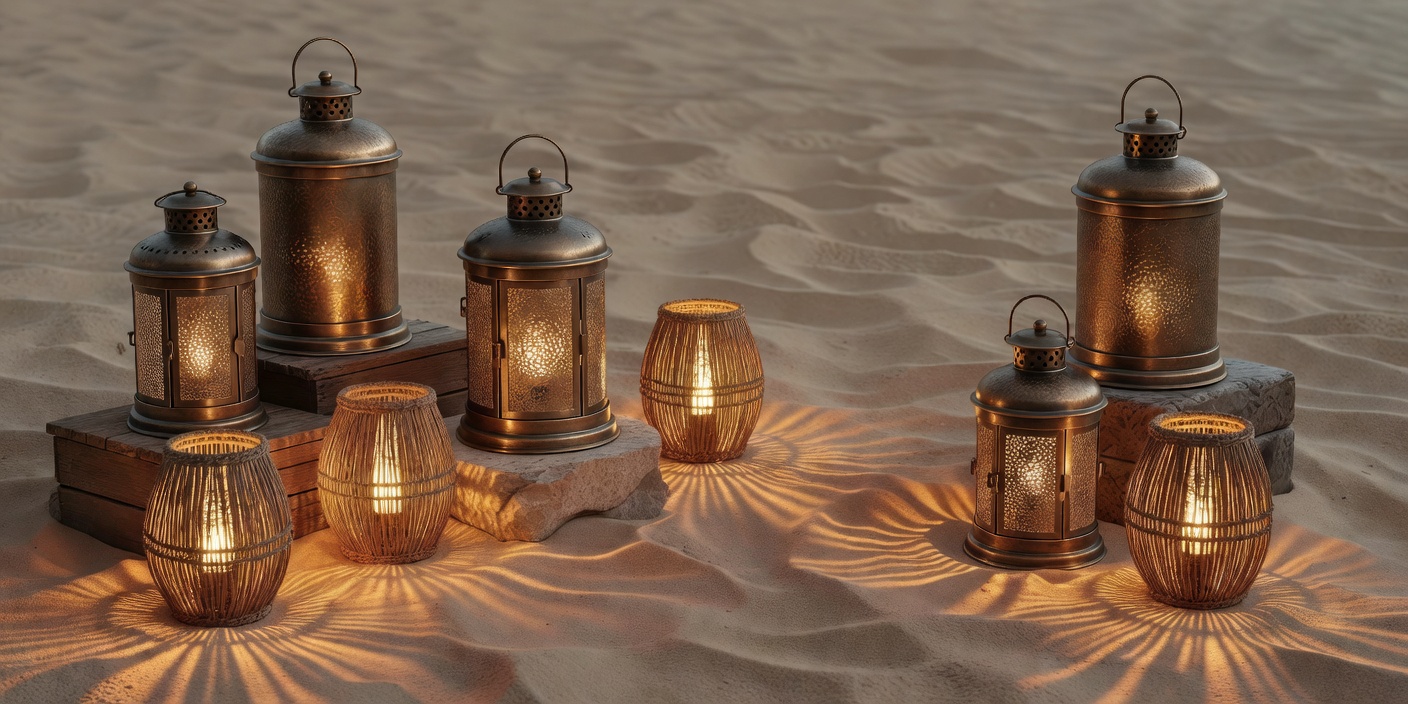
Floor-Grazing Reed or Ceramic Lanterns (15–30 cm high)
Placed in the far corner opposite the doorway, a weighted floor lantern washes warm light across timber decking tiles and anchors the distant edge of the space.
Shielded Portable Table Lamp (55–75 cm high)
A rechargeable IP65 aluminum lamp with an opaque dome shade directs 100% of its lumens downward onto your table surface, providing crisp reading light with zero upward glare.
Foliage Backlighting (40–80 cm high)
Tucking a warm micro-spotlight behind an olive tree or ornamental grass turns the leaves luminous against the dark backdrop, creating instant depth when viewed from indoors.
“Look at the light, never at the bulb. When every filament is hidden beneath a shade or behind a leaf, a two-square-meter balcony feels like a private candlelit terrace.” — Lighting notes for high-density apartments
2. Understanding IP Ratings, Lumens, and Kelvins
Many apartment balconies lack an exterior GFCI weatherproof power outlet, and pinching an indoor cord through a door seal ruins thermal insulation. Modern lithium-ion rechargeable lamps and detached solar panels have solved this completely, provided you check three technical specifications before buying.
| Fixture Type | Ideal Colour Temp | Output (Lumens) | Min. Ingress Rating |
|---|---|---|---|
| Reading & Dining Table Lamp | 2700K (Warm White) | 120 – 180 lm (dimmable) | IP54 (Splash resistant) |
| Floor Corner Lantern | 2200K (Candle Amber) | 40 – 80 lm | IP65 (Rain-jet sealed) |
| Planter Uplight Spike | 2400K (Sunset Gold) | 35 – 60 lm | IP67 (Immersion safe in wet soil) |
| Under-Bench Linear Strip | 2200K – 2400K | 90 lm per meter | IP65 silicone-encased sleeve |
3. Dark-Sky Courtesy and Insects
Nocturnal insects are strongly attracted to short-wavelength blue and ultraviolet light spectra (above 3500K). By restricting your balcony fixtures to 2200K–2400K amber LEDs and keeping total output under 300 lumens across the entire balcony, you dramatically reduce moth and gnat activity near your doorway while respecting DarkSky International guidelines for urban wildlife and neighbors’ sleep.